What Makes a Sign ADA Compliant Under Section 703?
Federal civil rights law drives every requirement for ada compliant signs in commercial buildings. The Americans with Disabilities Act prohibits discrimination against people with disabilities in everyday activities. Accessible signage is one of the tools that puts that protection into practice. You won’t find the word “sign” anywhere in the ADA’s actual text, though. Instead, ada sign requirements live inside the law’s broader communication-features provisions, with Section 703 laying out the technical specifics for tactile and visual signage.
That structure matters for you as a property manager or business owner. You can’t just skim the ADA itself looking for signage rules. You have to know that Section 703 is where the details sit.
What Does Section 703 Actually Cover?
Section 703 addresses the physical characteristics that make signage usable by people with visual and tactile impairments. It sets standards for character proportions, contrast, and the tactile elements that let someone read a sign by touch rather than sight. Tactile signs, raised-character signs identifying permanent rooms and spaces, fall squarely under this section.
Three categories typically require Section 703 compliance:
- Permanent room identification (restrooms, exits, stairwells)
- Directional and informational signage in public-use areas
- Signs paired with braille sign requirements for tactile reading
You need working knowledge of these categories before you plan any building signage. Signs East, based in Kingston, New Hampshire, designs and fabricates ADA signage in-house alongside channel letters, monument signs, and wayfinding for clients across Southern New Hampshire and North Shore Massachusetts.
What Is the ADA Sign Mounting Height Requirement?
Forty-eight inches marks the floor for tactile character placement on any compliant sign. Section 703.4.1 sets that number as the minimum mounting height, measured to the baseline of the lowest tactile character on the sign. Miss that threshold and your building falls out of compliance immediately, regardless of how well the sign reads or how much it cost to make.
The same section caps the top end at 60 inches, measured to the baseline of the highest tactile character. That range, 48 to 60 inches, gives you the full legal window for ada sign mounting height on any door-mounted or wall-mounted tactile sign. Go above or below it and the sign fails inspection even if every other spec checks out.
Where exactly does the sign need to sit relative to the door?
Placement matters as much as height. Section 703.4.2 requires ada compliant signs to sit on the latch side of the door, not the hinge side. A person reading by touch does not need to reach across a swinging door. An 18-by-18-inch clear floor space must sit centered on the tactile characters, positioned beyond the door’s swing path. A wheelchair user or a visitor with a cane can approach without obstruction.
Do these height rules apply to Braille the same way as raised letters?
Yes. Braille sign requirements follow the same 48-to-60-inch band as the tactile lettering above it. Braille sits directly below the raised characters on the same sign. Property managers handling multi-tenant buildings across Southern New Hampshire and North Shore Massachusetts often install signage built to these exact mounting specifications. Every tactile sign on the property reads consistently at the same reach height from unit to unit.
What Do Braille and Tactile Sign Rules Require?
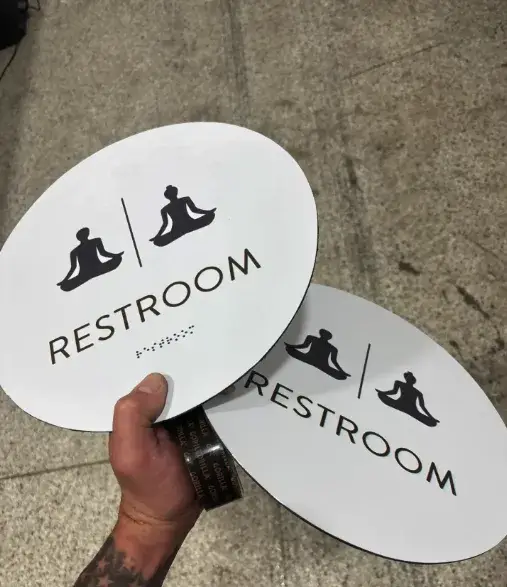
Braille sign requirements cover raised dots paired with raised lettering so a person who cannot read print can identify a room by touch. Tactile signs carry both elements together, never Braille alone, since sighted staff and visitors rely on the raised letters too. Getting the layout wrong means a costly reprint, not a minor fix.
Placement matters as much as content. Ada sign mounting height rules set a firm range: measured from the baseline, the lowest tactile character sits no lower than 48 inches, and the highest sits no higher than 60 inches, under Section 703.4.1. Miss that window and the sign fails inspection even if the wording is correct.
Where Should Tactile Signs Be Mounted on the Wall?
Mounting location depends on door swing and wall space, not guesswork. Signs typically go on the latch side of the door, with clear floor space in front so a person using a wheelchair can approach and read the sign without the door swinging into them.
Can an Older Sign Be Brought Up to Code?
Yes. Many buildings across Southern New Hampshire and North Shore Massachusetts still carry room signs installed decades ago, long before current ada sign requirements tightened up character height and Braille placement. A shop that repairs signs it did not originally build can retrofit those older tactile signs to current standards instead of ripping out the whole system.
For ada compliant signs, coordination with your local building department also matters, since permitting and documentation vary by municipality. This Kingston-based sign shop has produced signage for Southern New Hampshire businesses. That shop experience covers permit coordination as part of its ADA sign design and installation.
Which Buildings and Signs Must Meet Section 703?
Public buildings and commercial facilities open to customers fall under Section 703 whenever accessibility law requires accessible features anywhere in the structure. Office suites, retail storefronts, medical practices, and multi-tenant properties across Southern New Hampshire and North Shore Massachusetts all qualify. Chapter 7’s communication provisions, covering ada sign requirements for signage, apply wherever Chapter 2 calls for accessible features or another code section references them. Building type doesn’t grant an exemption; occupancy and use trigger the obligation.
That means restrooms, exits, permanent rooms, and paths of travel typically need ada compliant signs identifying them correctly. Rooms that change purpose regularly, like a conference room booked under different names, usually skip the tactile requirement entirely, since the space isn’t “permanent” under the code definition. Permanent spaces need raised characters and braille sign requirements satisfied. Visitors who are blind or have low vision can find them without assistance.
Coverage breaks down roughly like this:
- Always covered: restrooms, exits, stairwells, elevators, rooms with a fixed function
- Often exempt: temporary or frequently renamed spaces
- Depends on layout: corridors and directories, evaluated case by case
Does Every Door in a Commercial Building Need an ADA Sign?
No. Only doors leading to permanent rooms and spaces, like restrooms, stairwells, and exits, require code-compliant signage. Doors to spaces used temporarily or renamed often are typically exempt from tactile signs and ada sign mounting height rules.
As a property manager or facility director, you’re responsible for knowing which doors in your building trigger these requirements before an inspection flags them. A single mislabeled or missing sign at a required location can stall an occupancy inspection and delay your certificate.
Why Does ADA Sign Compliance Matter for Owners?
Non-compliant signage locks out a large share of the people walking through your door. A meaningful share of the people who visit any building live with a disability, and they are the ones directly affected when your building lacks ada compliant signs. For a property manager or facility director, that’s not an abstract concern. It’s a measurable slice of tenants, customers, and employees who may not be able to find a restroom, exit, or office suite without functioning tactile signs and clear wayfinding.
Meeting ada sign requirements protects your business from liability and keeps your building usable for everyone who enters it. Skipping compliance doesn’t just risk a complaint or a fine. It actively excludes people, and it signals to visitors that accessibility wasn’t part of the plan.
What happens if a building skips ADA signage?
A building without proper braille sign requirements or correct ada sign mounting height creates real barriers for visitors with vision or mobility impairments. Someone using touch to navigate a hallway may not locate the right room or may miss an exit entirely during an emergency. That failure exposes owners to complaints and puts people at risk, which is exactly what the ADA was written to prevent.
Who handles compliance-focused sign production locally?
Property managers across Southern New Hampshire and North Shore Massachusetts don’t have to search far. This Kingston, NH sign shop puts compliance-focused sign work within reach of the surrounding service area. The shop has installed signage for commercial buildings across the Seacoast and North Shore Massachusetts, giving facility directors a long-standing local resource for this kind of work.
FAQ
Where does Section 703 fit within the ADA?
Section 703 sits inside the ADA’s broader communication-features provisions. The law’s actual text never uses the word “sign.” It provides the technical specifics for tactile and visual signage compliance.
What height range applies to tactile characters on a sign?
Section 703.4.1 sets the mounting height window between 48 and 60 inches, measured to the baseline of the lowest and highest tactile characters. Signs outside this range fail inspection regardless of other specifications.
On which side of a door must an ADA sign be placed?
Section 703.4.2 requires the sign to sit on the latch side of the door rather than the hinge side. This placement lets a person reading by touch avoid reaching across a swinging door.
Conclusion
In closing, ADA compliance under Section 703 represents a fundamental commitment to accessibility and legal obligation for any business displaying signage. Meeting these standards, through proper contrast ratios, tactile elements, character sizing, and mounting heights, ensures your facility welcomes all visitors while mitigating liability exposure. Compliance is not negotiable; it is the baseline expectation for responsible commercial signage in today’s regulatory environment.