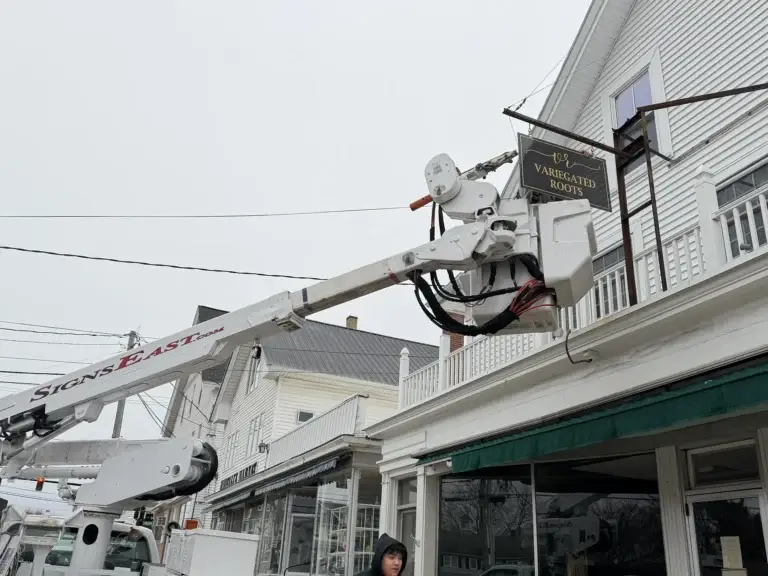
Flickering or half-dark signs usually trace back to failing ballasts, loose wiring, or dying LED modules inside the cabinet, not the whole unit. Signs East diagnoses and repairs various sign types, ensuring timely service.
Tor Larson, owner of Signs East, sees the same pattern every fall: “Once the time changes, they realize their signs are broken.” Shorter days mean your sign runs more hours after dark, so a dim section or flicker that went unnoticed all summer suddenly becomes obvious to every driver passing by. sign repair.
What Does It Mean When a Sign Is Half Lit?
A half lit sign shows some letters, panels, or tubes bright while others stay dark or dim, even though the power to the cabinet is on. Partial illumination like this points to a localized failure rather than a total shutdown. Your sign can be technically powered on and still fail to represent your business well. Dim or uneven sections read as neglect from the street.
Customers form an opinion about a property within seconds, and that judgment gets harsher after dark. A storefront with sign lights not working on one side can look closed even during business hours. Property managers and retail supervisors often catch the problem only when a tenant. Passerby mentions it, which means the sign has already been sending the wrong message for days or weeks.
What Causes Half Lit Signs?
Half illumination usually traces back to one of a few mechanical issues:
A failed ballast or driver feeding only part of the cabinet
Corroded wiring or a loose connection cutting power to certain letters
A burned-out section of LED modules or neon tubing
Sign power supply failure isolated to one circuit within a multi-section sign
Is a Half Lit Sign an Emergency?
Not usually, but it should not sit unaddressed for long. A partial outage often signals the early stage of sign not lighting up entirely, and waiting allows the underlying wiring or driver problem to spread to healthy sections.
Signs East repairs neon, LED, channel letter, cabinet, monument, and pylon signs across Southern New Hampshire, the Seacoast, and North Shore Massachusetts, including units it did not originally build. That means property managers do not need to track down the original installer just to get a dark section relit.
What Causes a Business Sign to Flicker?
Three mechanical failures account for nearly every flickering sign: a sign power supply failure, a loose electrical connector, or moisture that has worked its way into a joint. The light source itself, whether neon tube or LED strip, rarely causes the problem. Diagnosing sign lights not working correctly starts with ruling out the power components before touching the lamp.
Traditional neon signage runs on a different principle than LED. True neon tubes draw several kilovolts of alternating current through a transformer. That current naturally produces a dark or partially lit phase during every electrical half-cycle. A failing transformer, worn electrodes, a spent gas fill, or a cracked tube all show up as visible sign flickering or uneven glow. When a neon sign develops a half lit sign appearance, with one section bright and another dim. Dark, the culprit is usually electrode wear or a gas leak inside the tube itself.
Why does my LED sign flicker instead of staying lit steadily?
Led sign flickering almost always traces back to the driver or power supply, not the diodes. Loose wiring connections at a junction box, water intrusion at an outdoor joint, or a degraded power supply can all interrupt the steady current LEDs need. Since LED diodes rarely fail on their own, a flickering LED cabinet points you straight to the electrical components feeding it.
What if my sign isn't lighting up at all?
A sign not lighting up at all points to a complete circuit failure rather than a partial one. Check these common points before assuming the whole unit needs replacement:
Power supply or transformer output
Wiring connections and junction points
Moisture or corrosion at outdoor seals
Breaker or disconnect switch at the building
Working through each point in order, from the power source outward to the lamp, narrows the failure down before any part gets replaced unnecessarily.
Why Is a Sign Not Lighting Up at All?
A sign not lighting up at all usually means power never reaches the light source, not that the whole unit failed. A completely dark sign hides a business from view rather than simply looking less attractive after sunset. Customers driving past a storefront at night assume the business is closed when the sign stays black. That assumption costs foot traffic you never see walk away.
Several culprits cause total darkness. Sign power supply failure ranks among the most common reasons a cabinet or channel letter set goes fully dark. The transformer or driver feeds every component downstream of it. A break anywhere in that chain, a tripped breaker, a corroded connection, a failed ballast, stops light output completely, even if every bulb or diode inside is still good.
LED and neon signs fail differently, but both leave visible clues before going fully dark.
What are the warning signs before a sign goes completely dark?
Watch for these indicators before a half lit sign turns into a fully dark one:
Dead modules scattered across the face
Dim sections that used to shine evenly
Colors that have visibly drifted from the original hue
Any of these point to LED component failure working its way toward a complete outage.
Can a dark sign be fixed without full replacement?
Replacement is not the only option once a sign goes dark. Failed LED components get replaced directly, and aging neon or fluorescent cabinets get converted to efficient LED systems that cost less to run over time. Old fluorescent and neon cabinets take LED retrofits instead of requiring a full rebuild, which keeps a working cabinet in service rather than sending it to a landfill.
How Can You Spot Weak or Uneven Sections?
Spotting weak sections starts with distance, not close inspection. Park across the street or stand at the sidewalk where customers actually walk, then look at the sign from that vantage point rather than from directly underneath it. Uneven lighting hides up close but shows up clearly from the road at night. Emergency sign repair can help fix visibility issues.
From that distance, ask a few pointed questions. Does one letter look weaker than the rest of the sign? Is one side of the cabinet darker than the other side? These patterns often signal a half lit sign or an early-stage sign power supply failure, even when the sign technically still turns on.
What Does a Half-Lit or Uneven Sign Usually Mean?
A half lit sign often points to a failing component on one circuit, not a total electrical breakdown. One section keeps pulling power while a neighboring section dims or drops out entirely. Sign lights not working across a whole cabinet is a different problem than a single weak letter, and tracking which section fails first narrows down the cause quickly.
Common patterns worth watching for:
Sign flickering in one letter while the rest stay steady, often a loose connection.
LED sign flickering across an entire row, usually pointing to a driver or power supply issue.
A sign not lighting up at all on one side, while the other side runs fine.
Dimming that worsens after dark or in cold weather, a common sign power supply failure symptom.
A sign does not need to go fully dark to hurt a business. Partial darkness still hides the storefront from anyone driving by at night. Uneven letters read as neglect even when most of the sign still works. Whatever the pattern, Signs East gets it lit and working again, no matter which type of sign is on the building.
When Should You Call a Sign Repair Company?
Call a repair company the moment you notice sign lights not working or a sign that flickers every time someone walks past your building. Waiting rarely helps. A flickering sign grows more unprofessional every time a customer sees it. Repeat exposure to the same damaged sign does lasting harm to how your business looks from the road.
Cosmetic problems are not the only concern. Sign flickering can also point to an electrical fault. While a serious wiring problem is uncommon, you should treat it as a safety issue until someone rules that out. A half lit sign or a cabinet with dead sections often signals the same underlying failure, just caught at an earlier stage.
What if my sign is not lighting up at all?
A sign not lighting up usually traces back to one of two places: the power supply or the connection feeding it. LED sign flickering often points to a failing driver rather than the LEDs themselves. sign power supply failure shows up as complete darkness or sections that cut in and out.
Does the type of sign affect who you should call?
Yes. Neon repair requires a shop that still works with tube systems and transformers, a skill fewer local shops maintain. Owner-operated setups also matter here. A one-person shop puts you in direct contact with the technician doing the diagnostic work rather than a dispatcher relaying information secondhand.
Before calling, check:
Whether the flicker happens at all hours or only at certain times
Whether one section is dark or the entire sign has dimmed
Whether the sign trips a breaker or stays on continuously
FAQ
What causes a business sign to flicker?
Flickering nearly always traces back to a failing power supply, a loose electrical connector, or moisture in a joint, not the neon tube or LED strip
Conclusion
In closing, flickering and half-dark signage represents a direct loss of visibility and customer engagement, issues that demand immediate diagnosis and repair. Whether the root cause stems from electrical failure, component degradation, or environmental damage, prompt professional assessment prevents further deterioration and restores your sign’s operational reliability. Addressing these problems promptly protects your investment and ensures your business maintains the consistent, professional appearance necessary to attract and retain customers.